True or False Day 16 – Take This True or False Challenge!
by
Welcome to our exciting True or False Quiz Challenge!
If you love testing your knowledge with fun and surprising facts, you’re in the right place. This quiz will keep you guessing as you decide which statements are true and which are totally false. Whether you’re a trivia lover, a curious learner, or just looking for a quick brain workout, these questions are perfect for you. Play now, challenge your friends, and see who really knows it all.
Let’s get started!
Question 1:
The capital of Burundi is Bujumbura.
False! Gitega became the political capital in 2019, though Bujumbura remains the economic center.
Question 2:
The human body has more DNA than there are stars in the Milky Way.
True! Each human body contains about 37 trillion cells with 2 meters of DNA each - totaling enough DNA to stretch from Earth to Pluto and back 17 times.
Question 3:
The currency of Laos is the Rupiah.
False! Laos uses the Kip (LAK). Rupiah is Indonesia's currency.
Question 4:
A neutron star's density is comparable to stuffing Mount Everest into a teaspoon.
True! Just one teaspoon of neutron star material would weigh about 4 billion tons - roughly Mount Everest's mass.
Question 5:
The first color photograph was taken in 1861.
True! James Clerk Maxwell created a ribbon image using red, blue, and yellow filters - though the colors faded quickly.
Question 6:
The Library of Alexandria was destroyed in a single fire.
False! It declined over centuries through multiple events including Julius Caesar's fire (48 BCE) and religious purges in 391 CE.
Question 7:
The inventor of the pacemaker was rejected by medical schools.
True! Wilson Greatbatch, an electrical engineer, created the first implantable pacemaker in 1958 after medical schools turned him down.
Question 8:
The human body contains enough carbon to make 9,000 pencils.
True! An average body's 16kg of carbon could produce about 9,000 pencil leads (graphite is pure carbon).
Question 9:
The capital of Nauru is Yaren.
True! This tiny island nation (21 km²) has no official capital, but Yaren serves as the de facto administrative center.
Question 10:
The first web browser was called WorldWideWeb.
True! Tim Berners-Lee created it in 1990 - it was both a browser and editor for his new 'World Wide Web' project.
Question 11:
The Tonga Trench is deeper than the Empire State Building is tall.
True! At 35,702 feet deep, the Tonga Trench could submerge the Empire State Building (1,454 ft) 24 times over.
Question 12:
The human eye can detect a single photon of light.
True! Under perfect dark-adapted conditions, our rods can respond to just 1 photon - the smallest possible light unit.
Question 13:
The first mobile phone call was made in 1973.
True! Motorola's Martin Cooper called a rival at Bell Labs from a 2.5-pound prototype - the call lasted just 30 minutes before the battery died.
Question 14:
The capital of Comoros is Moroni.
True! This volcanic island capital sits on Grande Comore island, where residents can see Madagascar on clear days.
Question 15:
The human skeleton completely regenerates every 7 years.
False! While bones constantly remodel, full regeneration takes about 10 years - slower for some bones like femurs.
Question 16:
The first digital voice recording was made in 1938.
False! The first true digital audio recording was made in 1971 - earlier attempts (like the 1938 Vocoder) were analog.
Question 17:
The capital of Vanuatu is Port Vila.
True! This Pacific island capital has one of the world's most disaster-prone locations, facing cyclones, earthquakes, and tsunamis.
Question 18:
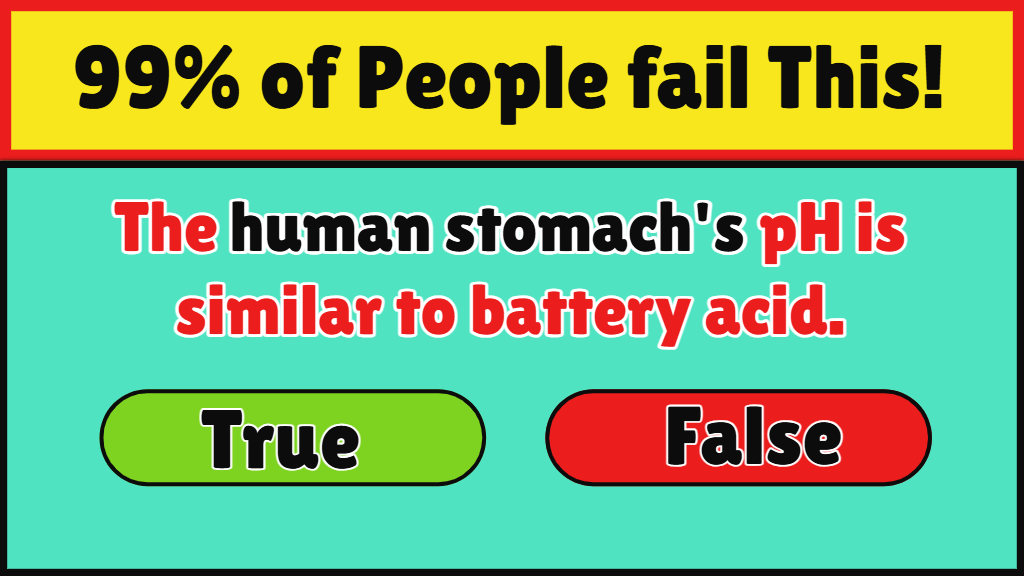
The human stomach's pH is similar to battery acid.
True! Gastric acid has a pH of 1.5-3.5 - comparable to car battery acid (pH 1.0). Mucus protects the stomach lining.
Question 19:
The first computer animation was created in 1960.
True! Bell Labs' Edward Zajac created a wireframe satellite rotation animation to demonstrate orbital mechanics.
Question 20:
The capital of Kiribati is Tarawa.
False! The capital is South Tarawa - an atoll comprising multiple islets connected by causeways.